Yuval Bloch — Complexity & Ecology
  • Home
  • About
  • Research
  • Publications
  • Blog
  • teaching
  • LEAN

Ecological-Modeling

Below you will find pages that utilize the taxonomy term “Ecological-Modeling”

Three lessons on Bayesian optimization, and one on humility

How a failed reproducibility test exposed three convergence bugs in my Bayesian optimization — stochastic simulations, unidentifiable parameters, and the wrong scale — and one lesson in humility I get in the way.

End of Greatness: Lacunarity and the Index of Transitional Homogeneity

The scientific journey is built on trial and error. After finding that a standard land-use index wasn't sufficient, I discovered the Index of Transitional Homogeneity (ITH)—and learned a lesson in the beauty of multidisciplinary science.

The Devil Is in the Details: Modeling Small-Scale Land-Use Change in Madagascar

Extended research materials for the zoological conference poster: Modeling smallholder land-use patterns and tick-borne disease risks in Madagascar.

Explaining the Lacunarity-Based Index for Spatial Heterogeneity

This technical post provides a comprehensive explanation of the Lacunarity-Based Index for Spatial Heterogeneity from Scott, R., et al. (2022). It covers the core concept of $\Lambda(r)$ (lacunarity at scale $r$), details the derivation of the standardized single index ($h$), presents a clear step-by-step toy example on binary maps, and provides a simple, functional Julia implementation for calculating the index across scales.


Sensitivity to Land Configuration

To ensure that my model accurately captures the impact of land configuration, I incorporate the diamond-square algorithm and the concept of fractal dimensionality. While these tools are unconventional for this purpose, they provide a robust and meaningful way to model spatial complexity and the effects of landscape structure.

Finding Viable Parameter Spaces with Sensitivity Analysis

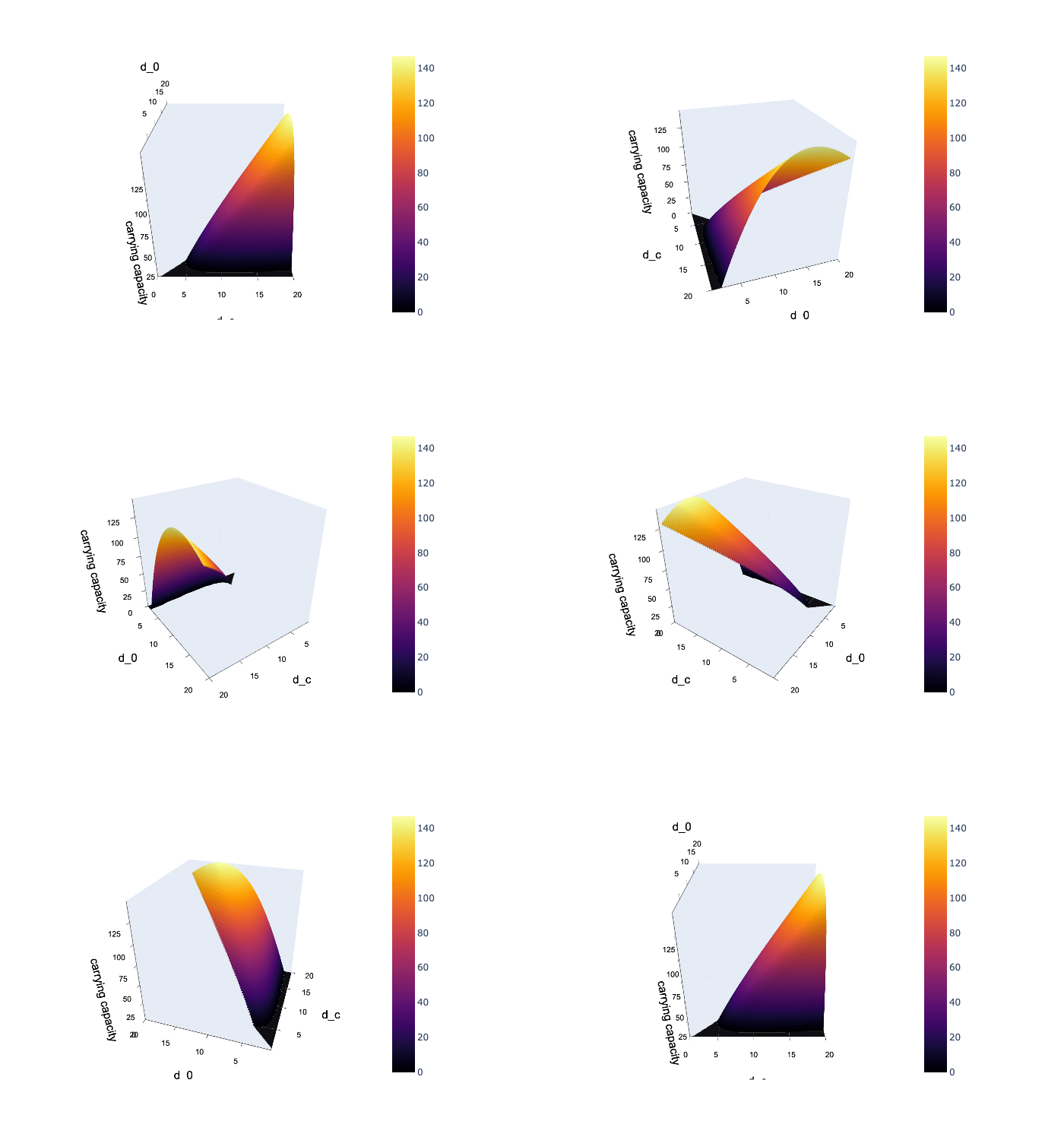
Using machine learning to map the ecological conditions under which tick populations persist or collapse, across a range of ecological and behavioral parameters.

Simulating Tick Life Cycles Across Landscapes

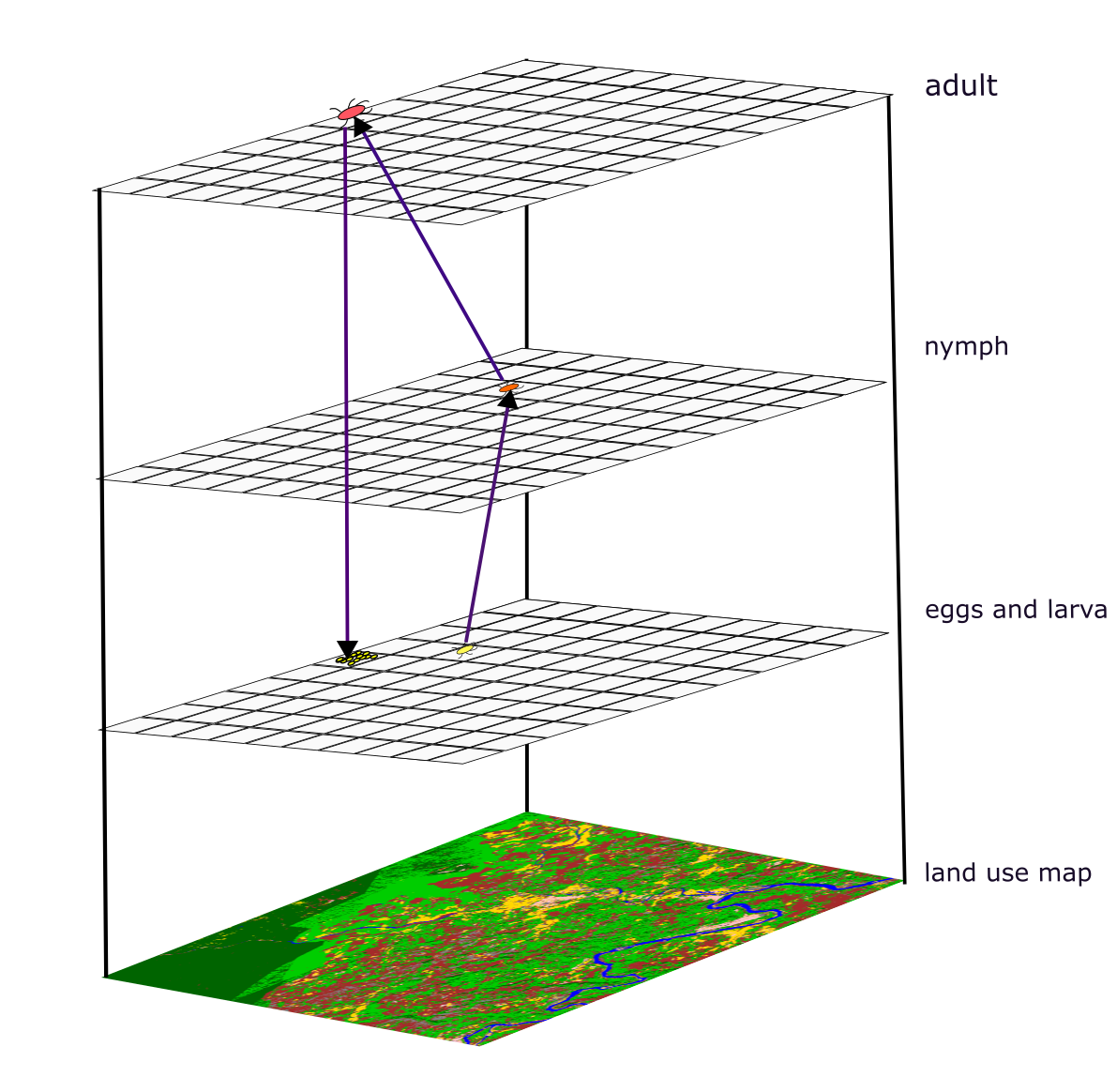
A layered simulation that captures how ticks grow, move, and spread through space—combining life stages, host behavior, and landscape patterns into a predictive ecological framework.

© Yuval Bloch — Complexity & Ecology 2026